
FedRAMP Continuous Monitoring Is Now Ongoing Certification: 2026 Rule Changes and Deadlines
FedRAMP 20x renamed continuous monitoring to Ongoing Certification, killed POA&Ms, and named nonhuman identity in the Key Security Indicators. Here are the 2026 rule changes, the Rev5 deadlines, and where most providers will fail.
Key takeaways
- FedRAMP's Consolidated Rules for 2026 took effect July 4, 2026 and renamed continuous monitoring to Ongoing Certification.
- POA&Ms are eliminated and replaced by a list of Accepted Weaknesses, and Word and Excel templates give way to simplified JSON.
- Key deadlines: January 1, 2027 for new Rev5 applications and active 20x offerings, June 11, 2027 for the last new Rev5 applications, and February 1, 2028 when grace periods end.
- Key Security Indicators require deterministic telemetry, so generative model output does not count as evidence.
- KSI-IAM names non user accounts and services directly, which makes nonhuman identity inventory, privilege visibility, and drift detection a certification requirement.
FedRAMP's Consolidated Rules for 2026 took effect on July 4, 2026. They changed more than the vocabulary. They changed what counts as proof. If you sell cloud services to federal agencies, the part of FedRAMP you used to call continuous monitoring is now called Ongoing Certification, and it is broader than the monthly scan and POA&M cycle most compliance programs were built around.
What changed on July 4
FedRAMP retired several terms that had caused years of confusion. Continuous Monitoring became Ongoing Certification. FedRAMP authorization became FedRAMP Certification. Impact Levels became Certification Class (A, B, C, D). The System Security Plan became the Security Decision Record. The 3PAO became the Assessor.
FedRAMP's explanation for the first swap is blunt. Continuous monitoring had become a synonym for vulnerability scans, and the new requirements are much wider than that. FedRAMP also states plainly that failing to perform them results in loss of FedRAMP Certification.
The old phrase survives in one place only. FedRAMP now uses continuous monitoring to refer to Collaborative Continuous Monitoring with agencies, the shared view of live certification data that agency customers review. Everything you owe FedRAMP itself sits under Ongoing Certification, and it now spans vulnerability detection and response, system changes, service health, incidents, and independent assessment in a single record.
Two changes every Rev5 program should read twice
- Plans of Action and Milestones are gone. POA&Ms have been eliminated and replaced with a list of Accepted Weaknesses, on the rationale that POA&Ms were mostly being used to accept weaknesses for extended periods anyway.
- Word and Excel templates are going away. The Certification Package moves to simplified JSON, with OSCAL optional in some cases. FedRAMP expects providers to populate these from real world data using automation rather than hand crafted documents.
The deadlines are already running. New 20x applications had to follow the 2026 rules as of July 4, 2026. New Rev5 applications and all active 20x offerings must follow them by January 1, 2027, or FedRAMP requests corrective action. FedRAMP stops accepting new Rev5 applications on June 11, 2027. On February 1, 2028 every grace period expires, and any offering not fully following the 2026 rules loses its FedRAMP Certification. FedRAMP states there will be no extensions past the default grace period.
The six month track record behind these rules
The 2026 rules did not arrive out of nowhere. Secureframe's six month look back at FedRAMP 20x lays the runway out as a timeline, and their graphic of the first six months is the clearest single view of how fast the program moved. The milestones worth citing:
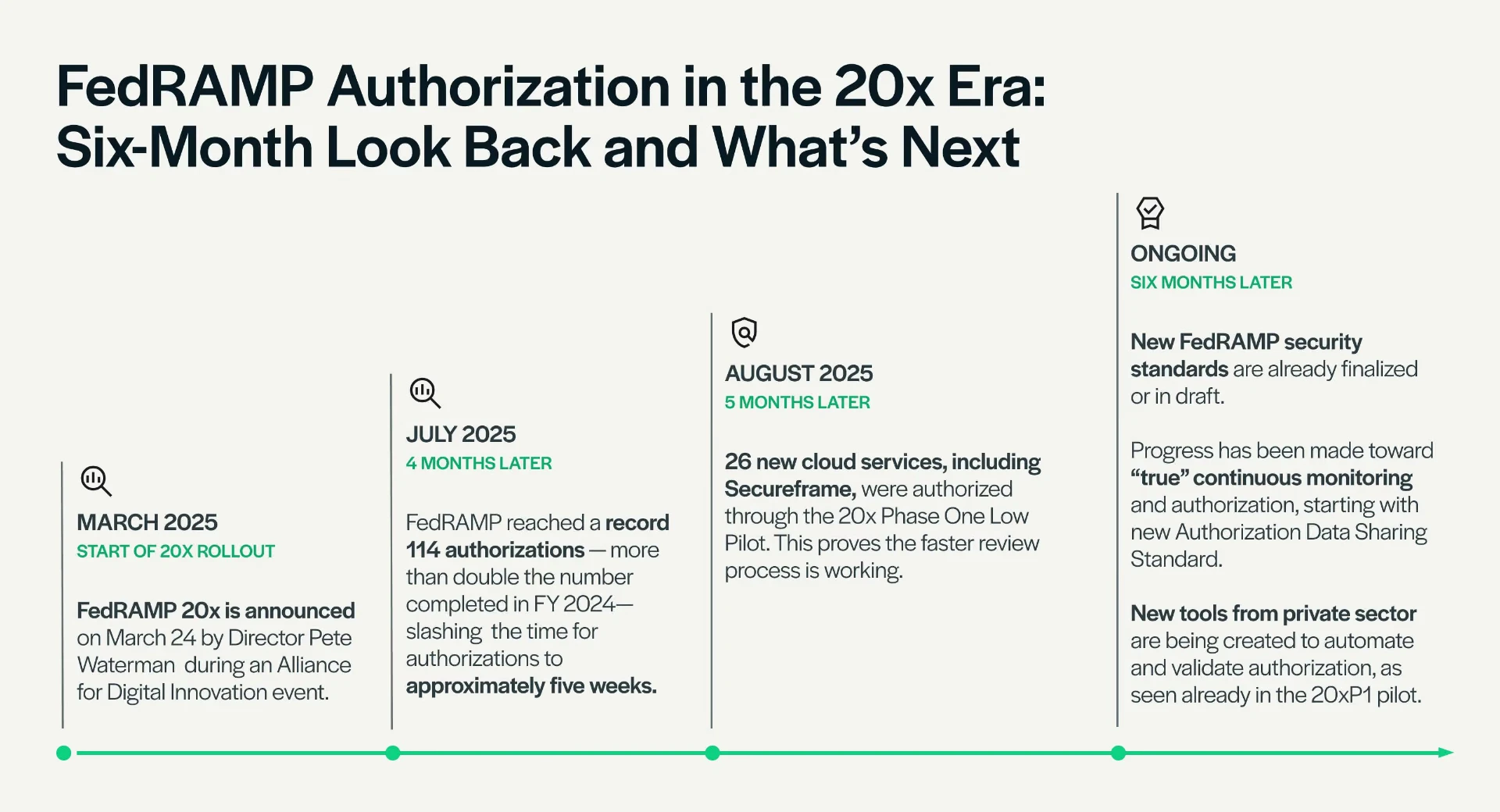
- March 2025, start of the rollout. FedRAMP 20x was announced on March 24 by director Pete Waterman during an Alliance for Digital Innovation event, per Secureframe's timeline.
- July 2025, record throughput. The FedRAMP team completed 114 authorizations in a single month, more than double the total for all of fiscal year 2024, with average authorization time cut to roughly five weeks against the legacy 12 to 18 month norm.
- August 2025, the Low Pilot landed. FedRAMP announced 26 new cloud services authorized through the 20x Phase One Low Pilot, including Secureframe itself. Secureframe notes that only 7 services had previously been authorized on the traditional Low baseline, a 270 percent increase in Low authorized services in the Marketplace.
- September 2025 onward, standards firming up. The Authorization Data Sharing Standard was finalized and draft standards including RFC-0016 Collaborative Continuous Monitoring and RFC-0014 Phase Two Key Security Indicators went out for comment, with the Phase Two Moderate Pilot announced September 24.
Secureframe's read on the continuous monitoring point matches what the 2026 rules formalized. They quote Waterman describing today's FedRAMP continuous monitoring as little more than annual assessments with periodic check ins, and describe the target state as systems that automatically detect, remediate, and report security risks in real time without a human in the loop. The July 4, 2026 rename to Ongoing Certification is that ambition written into the rulebook, which is why an annual access review no longer clears the bar.
Why the stakes are structural, not procedural
Under OMB M-24-15, the memorandum that governs the modern program, a FedRAMP authorization carries a presumption of adequacy for agency customers. That presumption is conditional. It applies as long as the authorization is actively maintained through ongoing requirements. Let the ongoing work lapse and the presumption goes with it, which forces every agency customer to re-evaluate whether they can keep using your service.
That is the real cost of an Ongoing Certification failure. It is not a fine. It is your entire federal customer base having to justify a decision they already made.
Key Security Indicators changed the shape of the evidence
FedRAMP 20x asks providers to demonstrate security capabilities instead of narrating compliance with controls. Key Security Indicators act as an abstraction layer over NIST SP 800-53 controls, with packages that must be machine readable, backed by evidence, and validated automatically wherever possible.
FedRAMP's guidance is direct about what it expects providers to build. Processes fulfilling a Key Security Indicator should continuously collect evidence, detect configuration drift, monitor control effectiveness over time, alert on deviations from baselines, and produce measurable trends.
One definition constrains how you can build that. FedRAMP defines deterministic telemetry as verifiable data collected directly from an authoritative source, representing a factual and reproducible observation of system state, configuration, or behavior. The accompanying note rules out probabilistic inference and generative model output as a source of deterministic telemetry. Read that carefully if you are evaluating vendors. An AI layer that summarizes your posture is not evidence. An API derived observation of your actual configuration is. The two are frequently sold as the same product.
Nonhuman identity is now named in the requirements
This is the part most providers have not priced in. The Identity and Access Management indicator family in the 2026 rules includes sub indicators that apply directly to accounts no human ever logs into.
- KSI-IAM-SNU, Securing Non-User Authentication: secure authentication methods must be used and persistently reviewed for non user accounts and services. That is a machine identity requirement stated in plain language.
- KSI-IAM-JIT, Authorizing Just in Time: a least privileged, role and attribute based, just in time authorization model, persistently reviewed, for all user and non user accounts and services.
- KSI-IAM-AAM, Automating Account Management: the lifecycle and privileges of all accounts, roles, and groups managed with automation.
- KSI-IAM-ELP, Ensuring Least Privilege: access measures persistently reviewed so each user or device reaches only what it needs.
- KSI-IAM-SUS, Responding to Suspicious Activity: privileged accounts disabled or otherwise secured when activity looks wrong.
Note the word persistently doing heavy lifting across four of these. FedRAMP defines it as a firm, steady activity repeated over a long period, where the status of the activity is always known. The definition explicitly replaces the historically loose federal use of the word continuous. An annual access review does not satisfy it.
The adjacent indicators tighten the loop further. Policy and Inventory expects a current inventory of deployed assets, and the rules define drift to include deviations in privileges, not just configurations and deployed software. Put those pieces together and the requirement is concrete. You need to know every service principal, IAM role, access key, managed identity, OAuth grant, and workload credential inside your boundary, what each one can do, and when that changes, produced as data, repeatedly, on demand.
That gap is normal, and under the 2026 rules it is now a certification problem rather than a hygiene problem.
Where Avistar fits
Avistar discovers nonhuman identities across AWS, Azure, and Google Cloud, scores their risk, and outputs the result as structured data. For a provider working toward or maintaining FedRAMP Certification, that maps to a defined slice of Ongoing Certification.
- Inventory of nonhuman identities: automated enumeration of machine accounts, roles, service principals, and credentials across all three major clouds, refreshed on a schedule rather than assembled by hand before an assessment.
- Privilege visibility: classification of what each identity can actually reach, which is the evidence layer under least privilege and just in time claims.
- Drift detection on identity: change in privilege between scans is exactly the deviation FedRAMP wants alerted on, and the category of drift manual review misses most often.
- Machine readable output: findings come out as structured data your GRC platform or Security Decision Record process can consume, not as a PDF someone has to retype.
- Stale and orphaned credential findings: keys and identities that outlived their purpose are the clearest form of a non user authentication weakness, and the easiest to remediate before an assessor sees them.
What Avistar is not
Being specific about scope matters more than sounding comprehensive. Avistar is not an assessor. We do not perform FedRAMP independent assessments and we do not issue certifications. Use a FedRAMP Recognized independent assessment service for that.
Avistar is not a GRC platform. We do not assemble or submit your Certification Package, maintain your Security Decision Record, or manage your Accepted Weaknesses list. Vendors in that category do that work, and Avistar output is designed to feed into them. Avistar also does not cover the other indicator families such as recovery planning, cybersecurity education, or supply chain risk. Avistar covers nonhuman identity, a portion of Ongoing Certification that generic posture tooling consistently underreports because service accounts do not show up in user centric access reviews.
If you are on Rev5 today
Do not assume this is a 20x only problem. The 2026 rules apply significant changes to Rev5 as well, including large adjustments to Ongoing Certification requirements that every provider must adopt within the stated timelines. Existing Rev5 Certifications remain active until at least December 31, 2028, but the identity work does not get easier by waiting, and the evidence you build now carries directly into a 20x transition.
The providers who handle this well will treat identity evidence as a data pipeline they run continuously, not a document they produce annually. That is the whole thesis behind the 2026 rules.
Frequently asked questions
- Is FedRAMP continuous monitoring going away?
- The requirement is not going away, the name is. Under the 2026 rules the work formerly called continuous monitoring is called Ongoing Certification, and it now covers vulnerability detection and response, system changes, service health, incidents, and independent assessment. FedRAMP reserves the phrase continuous monitoring for Collaborative Continuous Monitoring, the shared live view agency customers review.
- What is the difference between Ongoing Certification and Collaborative Continuous Monitoring?
- Ongoing Certification is what a provider owes FedRAMP to keep its certification active. Collaborative Continuous Monitoring is the shared view of live certification data that agency customers review. Failing Ongoing Certification results in loss of FedRAMP Certification.
- What are the FedRAMP 2026 deadlines?
- New 20x applications followed the 2026 rules as of July 4, 2026. New Rev5 applications and all active 20x offerings must follow them by January 1, 2027 or FedRAMP requests corrective action. FedRAMP stops accepting new Rev5 applications on June 11, 2027. On February 1, 2028 every grace period expires and noncompliant offerings lose certification.
- Do the 2026 FedRAMP rules apply to Rev5 providers?
- Yes. The 2026 rules apply significant changes to Rev5, including large adjustments to Ongoing Certification requirements. Existing Rev5 Certifications remain active until at least December 31, 2028, but the new requirements must be adopted within the stated timelines.
- How does nonhuman identity relate to FedRAMP Key Security Indicators?
- The Identity and Access Management indicator family names non user accounts and services directly. KSI-IAM-SNU requires secure, persistently reviewed authentication for non user accounts, KSI-IAM-JIT requires just in time authorization for user and non user accounts, and KSI-IAM-AAM requires automated account lifecycle management. Meeting them requires a current inventory of service principals, IAM roles, access keys, managed identities, and workload credentials, plus alerting on privilege drift.
- Can AI generated summaries count as FedRAMP evidence?
- No. FedRAMP defines deterministic telemetry as verifiable data collected directly from an authoritative source, and explicitly rules out probabilistic inference and generative model output as a source of deterministic telemetry. API derived observations of actual configuration qualify, AI summaries of posture do not.
Sources
- https://www.fedramp.gov/2026/providers/updating/changes/
- https://www.fedramp.gov/2026/providers/updating/deadlines/
- https://www.fedramp.gov/2026/providers/20x/key-security-indicators/
- https://www.fedramp.gov/2026/providers/20x/key-security-indicators/identity-and-access-management/
- https://www.fedramp.gov/2026/definitions/
- https://github.com/FedRAMP/community/discussions/3
- https://secureframe.com/blog/fedramp-authorization-six-months-after-20x-announced
- https://www.gsa.gov/about-us/newsroom/news-releases/gsa-celebrates-major-fedramp-milestones-08112025
- https://www.fedramp.gov/2025-08-28-fedramp-20x-five-months-in-and-full-of-surprises/
- https://www.whitehouse.gov/wp-content/uploads/2024/07/M-24-15-Modernizing-the-Federal-Risk-and-Authorization-Management-Program.pdf