
Black October Was the Warning. Black November Is the Test.
PHP2Shell, the ConnectWise supply chain attack, stolen AI keys, and a national lab breach landed in two weeks. Why AI flipped the economics of attack, why identity is the common thread, and what to do before November.
Key takeaways
- In two weeks of October 2026, PHP2Shell, an eMudhra key compromise, a CVSS 10 GitLab flaw, the ConnectWise supply chain attack, AI agent break ins, four AI platform secret leaks, and the Quest Diagnostics breach landed together.
- Attackers were trying to exploit PHP2Shell in the days before the October 21 patch, so log reviews should start before the patch date, not after it.
- Railway, Zeabur, LiteLLM, and OpenCode all exposed or targeted stored secrets, including API keys for AI providers.
- High severity CVEs from 21 notable vendors and open source projects went from a few hundred a month to close to 3,000 by September 2026, according to Epoch AI data.
- The ConnectWise attack ran through a stolen application credential. The attacker did not break the trust between systems; the trust did the work.
- Machine identities outnumber human ones 109 to 1 (Palo Alto Networks), and most organizations cannot say what each one can do.
Two weeks, ten incidents, one pattern
Here is how the second half of October unfolded. Read it top to bottom and watch the same story repeat: a trusted piece of software, a stolen or weak credential, and AI shrinking the time between finding a flaw and using it.
ConnectWise tenants come under attack
Attackers holding a stolen ConnectWise application credential start working through Microsoft 365 tenants run by MSPs and the businesses they protect. By October 15, about 50 systems Huntress monitored saw them use ConnectWise's own apps to assign themselves directory or administrative roles.
Zeabur is breached a second time
Zeabur's attacker reads 3.2 million environment variable records using credentials its August rotation did not cover.
A certificate authority's keys turn out to be guessable
eMudhra, a certificate authority in India, turns out to have generated the private keys for eight intermediate certificates so weakly that they could be recovered in under a second. One of the keys was the number 4. Browsers block them within hours.
ConnectWise pulls its backup service; Zeabur announces it is closing
Huntress confirms unauthorized sign ins in 173 tenants using the compromised ConnectWise credential, and ConnectWise suspends its Cloud Backup service. The same day, Zeabur says it is shutting down in December.
One hacker, AI agents, 100+ company websites
Reuters reports that one hacker used AI agents to break into more than 100 company websites, Deere, SharkNinja and Cummins among them. The instructions were fewer than 100 Chinese characters. The cost was about $50 per successful break in, by the researcher's estimate.
OpenCode users find AI bills they did not run
Some OpenCode users wake up to AI charges they did not make after the stored API keys for their AI providers were exposed.
Railway customer variables exposed
Railway says up to 100,000 workspaces may have had environment variables exposed during a roughly 38 hour attack window.
PHP2Shell: patch or go offline
PHP ships emergency patches for two flaws now called PHP2Shell. AI helped find them, and attackers were already trying to exploit them in the days before the fix existed. The NSA and FBI tell organizations to patch or take their sites offline, and Japan's Prime Minister gives the same advice. Government sites in the Netherlands, Finland, France and Denmark go offline, and UK councils and the Met Police go dark. PHP runs about 70% of the websites whose server-side language is known. That is not a bug in one app. That is the floor under most of the web.
GitLab patches a 10 out of 10 flaw
GitLab ships a patch for a CVSS 10.0 flaw: under certain conditions, unauthenticated code execution through a crafted regular expression. Affected versions go back to 7.0, which shipped in 2014. That bug sat in the code for more than a decade.
Microsoft names the group behind ConnectWise
Microsoft says a China-state aligned group used an agentic AI framework to run the ConnectWise supply chain attack, attempting sign ins to more than 2,250 Microsoft 365 tenants. Several of the group's AI driven attacks went from first contact to privileged access in under three hours.
LiteLLM ships a credential stealer
LiteLLM, a package with 23 million weekly downloads, serves a credential stealer for about two hours after its release pipeline is compromised.
Quest Diagnostics tells the SEC about a breach
Quest Diagnostics tells the SEC that someone got into Quanum LSM, the system physicians and hospital staff use to order tests and view results. Patient records were exposed. It is the latest in a run of medtech cyberattacks this year that includes Medtronic, Stryker, Abbott and Boston Scientific.
It gets a name
People start calling it Black October.
Railway, Zeabur, LiteLLM and OpenCode all lost customer secrets or shipped code built to steal them. In all four, the prize was the same. Stored secrets: environment variables, cloud credentials and API keys for AI providers.
I think it was the preview.
The economics flipped
Finding a flaw used to take a team and weeks. Now it takes a prompt and an afternoon.
Exploiting it used to take skill. Now it takes tokens.
The numbers back this up. Comcast Business analyzed 79.3 billion security events between March 2025 and February 2026 and found 47.9 billion initial access events and 288.9 million active scans. Their conclusion was blunt. Attacks cost less to launch, demand less skill, arrive in greater volume and look more convincing.
The NAIC's new cyber insurance market report puts a clock on it. Mean time to exploit a vulnerability fell from 2.3 years in 2018 to about 10 hours in 2026. AI-enabled attacks rose 89% year over year. Only 26% of critical vulnerabilities on CISA's known exploited list got fully remediated this year, down from 38%.
Attackers move at machine speed. Patching still moves at human speed.
Epoch AI tracks CVEs from 21 notable software vendors and open source projects. For four years, high-severity disclosures held steady at a few hundred a month. Then Anthropic announced Claude Mythos Preview on April 7 and the line went vertical. By September the same vendors were disclosing close to 3,000 high-severity flaws a month. Critical disclosures went from under 100 to about 600.
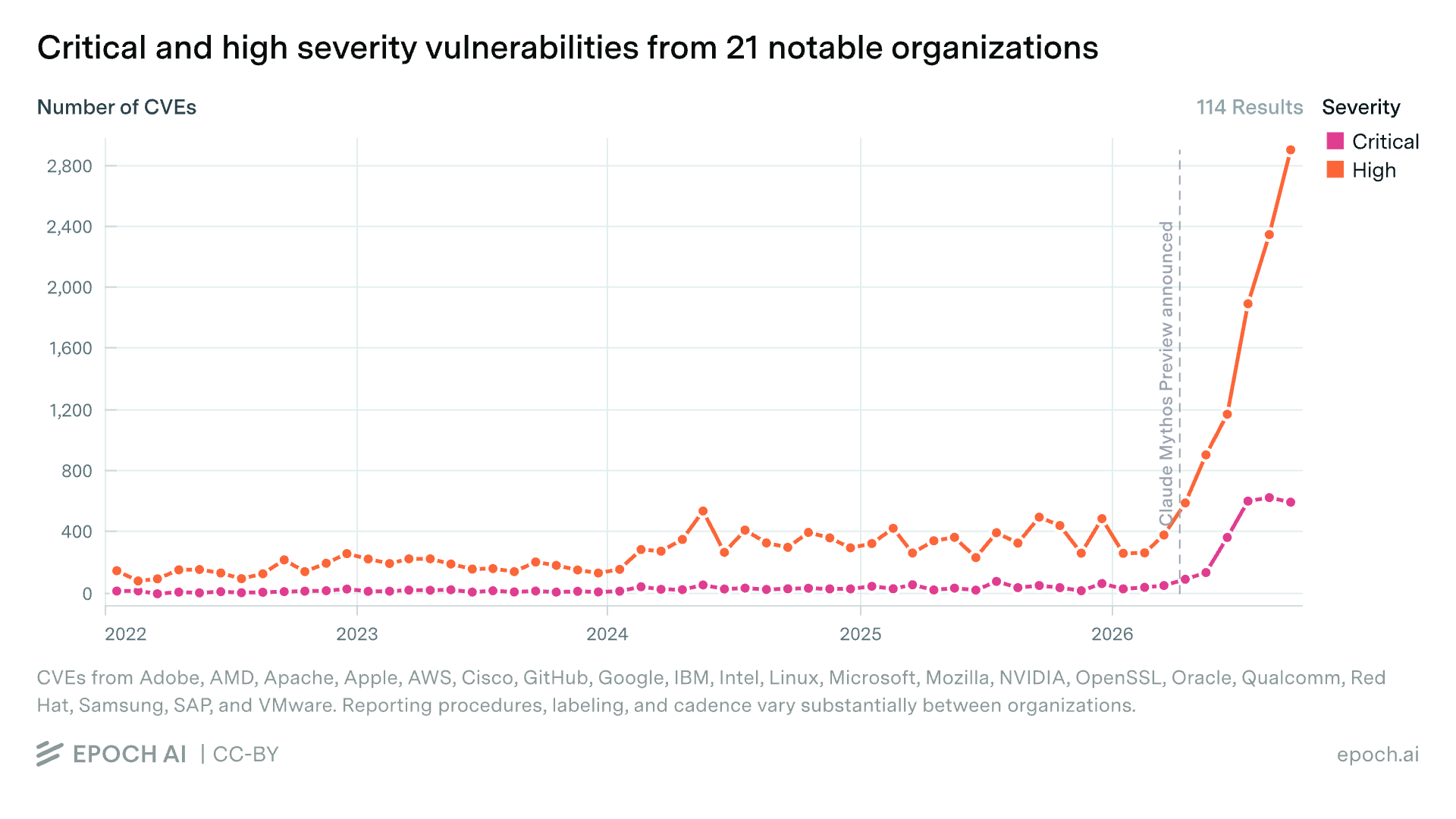
Across Epoch's full dataset the picture is the same. High-severity CVEs ran about 1,500 a month in early 2026 and passed 6,000 by September.
Those are not new bugs. They were always there. AI is finding them faster than anyone can fix them, and the same tools that find them for the vendor find them for the attacker.
$50 a breach is a price any criminal can pay.
Think about what that does to the ordinary attack. Scan a cloud tenant. Find a credential. Write the phishing email. Build the fake login page. Spoof the sender. Send the text that sounds like your CFO. Every step of that chain could already be automated. AI makes it cheap, fast and personal.
Our brains did not evolve for this. We trust a voice that sounds familiar. We trust an email that reads right. We trust a website that looks like our bank. Those instincts are now attack surface.
One analyst said it plainly this week. Now that the PHP patch is public, agents can study it and reproduce the attack. The fix is the blueprint.
That is the part I do not think the world is ready for. The cost of attacking went to zero. The cost of trusting did not.
Security is assurance, not a checkbox
When nothing is trustable, everything loses meaning.
If I cannot trust the news, I cannot know what is real. If I cannot trust my bank, I cannot plan. If I cannot trust that the water will run and the lights will stay on, I cannot build anything.
It gets hard to stand up for what is right. It gets hard to feel like you belong anywhere. A society that cannot trust itself fractures.
That is what cybersecurity actually protects. Not a compliance score. Assurance. The confidence that the institutions holding our money, our health records and our infrastructure will still be standing tomorrow.
I spent years inside a financial institution watching 700 APIs move $65 billion a day. What kept that running was not a product. It was trust between systems, written down as identities and permissions.
That problem has grown. There are now 109 machine identities for every human one in the enterprise, according to Palo Alto Networks. Comcast's report calls identity the connective tissue of the modern attack chain. Rapid7 found that valid accounts with missing or weak MFA accounted for 43.9% of its 2025 incident response investigations. One compromised credential carries the same exposure as an unpatched server on the internet.
Those identities are service accounts, API keys, OAuth apps and now AI agents. Most organizations cannot tell you how many they have or what each one can do.
ConnectWise showed what happens when one of those identities is stolen. The attacker did not break the trust. The trust did the work for them.
We need a collective level of trust with one another. That is not possible when I cannot trust the bank I bank with, or trust that my government will keep critical infrastructure running. Right now we make decisions on short-term results. Trust is a long-term asset. Those two things are in conflict, and October showed us which one wins by default.
The broccoli problem
I have been told security is a vitamin, not a painkiller. A nice to have. Broccoli. We know it is good for us and nobody wants it.
Here is the problem with that view. Decisions get made on a quarter or a budget cycle. Security does not show up in those numbers until it does, and then it is the only number.
Zeabur is the case study.
Breached in August. Rotated credentials, but the rotation did not cover the long-lived admin credentials. Breached again in October using credentials the August rotation missed. Shutting down by the end of December. Three and a half years of growth gone in two months.
Insurers are already watching PHP2Shell as a possible aggregation event. Cyber carriers are tightening what they will pay for. Unpatched systems, missing basic controls and negligence keep moving toward the exclusion list. When the breach lands and the policy does not pay, the business eats the full loss.
The regulators see the same thing. The NAIC's 2025 report shows the industry cyber loss ratio climbed to 53 from 48.7, the second straight increase, while carriers cut rates for an eighth straight quarter. Average claim severity for large businesses hit $4.4 million, up 586% since 2021. Breaches involving a third party jumped 60% and now make up 48% of all breaches. Carriers are pricing for a calmer world than the one October described. That gap closes one way. Higher premiums, tighter terms, more exclusions.
I am not sure how many small and mid-sized businesses survive that combination.
So the job for anyone in this field is to make broccoli look better to the people who sign the checks. Translate it. Boards understand revenue at risk, days of downtime, cost per record and whether the insurance pays out. Speak in those terms or do not expect the budget.
If you are inside an organization, do everything you can to convince leadership that this is worth investing in. Use October as the evidence. You will not get a cleaner example.
What Black November looks like
Black October was the beginning, not the peak.
The PHP patch is now a map for every agent that wants one. Stolen AI keys from four platforms are in circulation. Thousands of Microsoft 365 tenants were targeted and not all of them have been checked. Patient data from a national lab is sitting somewhere it should not be.
Expect the follow on. Agents replaying PHP2Shell against every site that has not patched. Phishing built on real patient records. Tenants with persistence nobody has found yet. Fake login pages that look exactly like the real thing because they were built from the real thing.
If you run an organization, here is what I would do this week.
- Patch PHP and GitLab. Read your logs from the week before October 21, not just after it.
- Inventory every application identity and service principal in your Microsoft 365 tenant. Find out what each one can do and which ones added credentials since October 13.
- Rotate every secret stored in a hosting platform or AI gateway. Assume anything in an environment variable was read.
- Ask your MSP what they did about ConnectWise. If the answer is vague, that is your answer.
- Take this to whoever controls the budget before November does it for you.
The technology is the easy part. The hard part is convincing people to eat the broccoli before they get sick.
Frequently asked questions
- What was Black October?
- Black October is the name given to a run of security incidents in October 2026, including the PHP2Shell flaws in PHP, the eMudhra intermediate certificate key compromise, a CVSS 10 GitLab flaw, the ConnectWise supply chain attack attributed to Storm-0940, AI agent driven website break ins, secret leaks at Railway, Zeabur, LiteLLM, and OpenCode, and the Quest Diagnostics breach.
- What should organizations do about PHP2Shell?
- Patch PHP immediately, and review logs from the days before October 21, when the patch shipped, because exploitation attempts were reported before the fix existed. The NSA and FBI advised taking unpatched sites offline.
- Why does the ConnectWise attack matter to MSP customers?
- The attacker used a stolen application credential to attempt sign ins to more than 2,250 Microsoft 365 tenants belonging to MSPs and their customers. Every tenant should inventory its application identities and service principals, check what each can do, and look for credentials added since October 13.
- Why were AI provider API keys targeted?
- AI provider keys can be used to run up compute on someone else's account. In October 2026, Railway, Zeabur, LiteLLM, and OpenCode all lost customer secrets or shipped code built to steal them, and some OpenCode users found AI charges they did not run.
Sources
- https://www.defenseone.com/threats/2026/10/critical-flaws-php-warning/416727
- https://tech-ish.com/2026/10/21/japans-pm-the-nsa-and-the-fbi-tell-websites-to-update-php-or-go-offline/
- https://www.insurancebusinessmag.com/uk/news/cyber/uk-councils-and-met-police-among-sites-pulled-offline-after-ncsc-alert-594424.aspx
- https://www.radiox.co.uk/news/uk-world/websites-warned-to-install-critical-php-softw/
- https://dev.to/sheersafe/php2shell-a-breach-and-a-key-called-4-are-you-exposed-14e3
- https://www.404media.co/php2shell-black-october-ai-is-changing-everything-about-hacking-no-one-knows-what-happens-next/
- https://www.washingtonpost.com/wp-intelligence/ai-tech-brief/2026/10/23/ai-tech-brief-black-october/
- https://en.wikipedia.org/wiki/Black_October_(information_security)
- https://www.eenewseurope.com/en/emudhra-certificate-compromise-php2shell/
- https://docs.gitlab.com/releases/patches/patch-release-gitlab-19-5-1-released/
- https://www.microsoft.com/en-us/security/blog/2026/10/21/storm-0940-uses-artex-agentic-ai-connectwise-supply-chain-compromise/
- https://www.bleepingcomputer.com/news/security/hackers-breach-microsoft-365-tenants-via-connectwise-supply-chain-attack/
- https://thehackernews.com/2026/10/hackers-use-compromised-connectwise.html
- https://therecord.media/connectwise-suspends-cloud-backup-service-supply-chain-attack
- https://www.staradvertiser.com/2026/10/19/breaking-news/how-one-hacker-used-ai-agents-to-break-into-over-100-company-websites/
- https://thenextweb.com/news/ai-agents-hacker-cairn-100-sites-deere-norforge
- https://blog.railway.com/p/security-disclosure-wednesday-october-21st
- https://blog.railway.com/p/preliminary-report-october-security-incident
- https://zeabur.com/blogs/october-2026-security-incident
- https://zeabur.com/blogs/zeabur-is-shutting-down
- https://www.bleepingcomputer.com/news/security/zeabur-shutting-down-after-second-security-breach-in-two-months/
- https://docs.litellm.ai/blog/security-incident-oct-21-2026
- https://securitylabs.datadoghq.com/articles/litellm-compromised-pypi-docker/
- https://thehackernews.com/2026/10/litellm-compromised-in-supply-chain.html
- https://techcrunch.com/2026/10/19/hackers-hit-ai-coding-tool-opencode-running-up-charges-on-users-ai-accounts/
- https://www.bleepingcomputer.com/news/security/opencode-hack-exposes-api-keys-amid-ai-distillation-attacks
- https://business.comcast.com/about-us/press-releases/2026/cb-2026-cybersecurity-threat-report
- https://content.naic.org/sites/default/files/2026-report-cybersecurity-insurance-market.pdf
- https://www.paloaltonetworks.com/idira/idira-identity-security-landscape
- https://www.rapid7.com/about/press-releases/rapid7-2026-global-threat-landscape-report-shows-exploited-high-and-critical-severity-vulnerabilities-surged-105-as-attack-timelines-collapsed/
- https://www.anthropic.com/research/mythos-preview
- https://www.sec.gov/Archives/edgar/data/0001022079/000094787126000941/ss6979200_8k.htm
- https://www.fiercebiotech.com/medtech/quest-diagnostics-test-results-system-breached-yet-another-medtech-cyberattack
- https://www.bleepingcomputer.com/news/security/quest-diagnostics-confirms-data-breach-exposed-patient-records/
- https://epoch.ai/data/cve?view=table&tab=monthly_by_cna